Benefits of Pilates: what does Pilates do to your body?
The benefits of Pilates for your core, posture, joints and mind, explained by a Randburg studio. See what to expect when you start.

Pilates makes your body stronger from the centre out, improves your posture, keeps your joints mobile and trains your mind to work with your muscles. Those are the core benefits of Pilates, and they show up in everyday life: you stand taller, your back complains less, and movements like lifting, gardening or running feel more controlled. Below we explain what Pilates actually does to your body, what our clients notice first, and what to expect when you start.
What does Pilates do to your body?
Pilates is a full-body method built around control, precision and breathing. Instead of working one muscle at a time, each exercise asks your deep core, your spine and your limbs to work together. Over time that changes how your body holds itself and how it moves.
It builds deep core strength
Many people who already train hard are surprised by how weak their deep core turns out to be. One of our long-standing clients, a competitive athlete who had lifted weights for years, told us exactly that: he thought he was fit until his first few Pilates classes showed him otherwise. Strengthening the deep abdominal muscles, the muscles along the spine and the pelvic floor gives your trunk a stable base, and many clients find this helps ease nagging lower back pain.
It lengthens and supports your spine
“Lengthen” is a word you will hear often in a Pilates class. Gravity, long hours of sitting and repetitive habits all pull the body down and forward. Pilates teaches you to use muscular control to lift through the spine instead of sinking into it, so you feel taller and more in control of your posture.
It balances your muscles
Muscles that are too tight or too weak on one side of a joint leave it vulnerable. Pilates works muscles through their full range and in all directions, so opposing muscle groups end up more evenly matched. Many clients find this helps keep their joints stable when they move, which is why so many athletes and sports teams use Pilates alongside their main training.
Posture, back and neck: benefits of Pilates you notice early
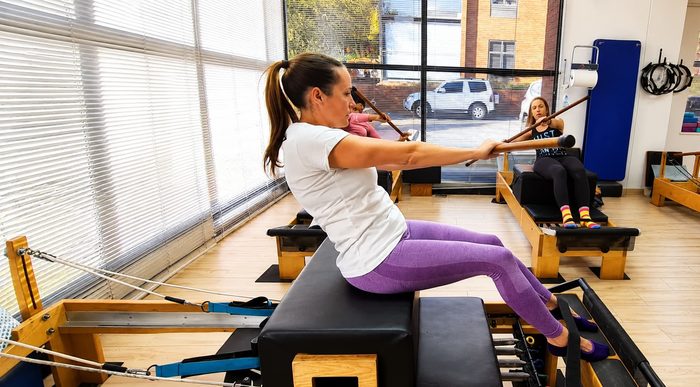
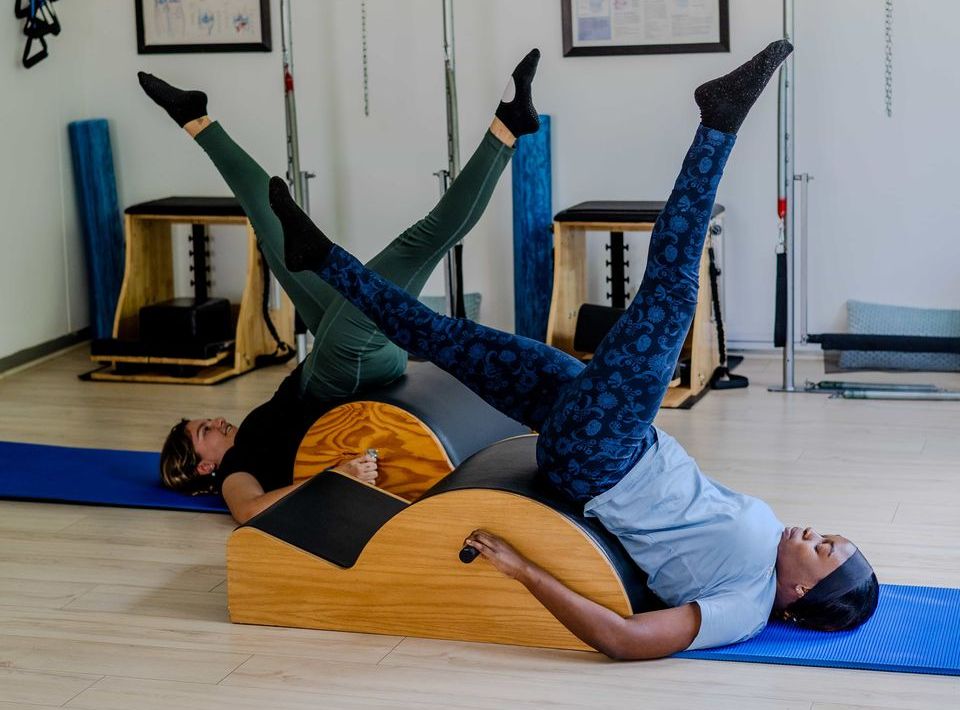
Posture is often the first change people see. The same athlete described a lifelong slouch he assumed he was simply born with. Through targeted work on the Reformer, Tower and Wunda Chair, plus mat work with small and large balls, and with clear cueing from his instructors, he gradually learned to sit and stand upright without thinking about it.
Your back is designed to move, and it tends to suffer most when it sits still all day or repeats the same one-sided motion, such as a golf swing. A well-rounded Pilates programme strengthens the many small muscles that support the spine and neck. If you have a diagnosed back or neck condition, such as a disc problem, check with your doctor or physiotherapist first. Our biokineticist, Aurelie, can also help you start safely.
How Pilates benefits your mind
An effective Pilates session asks a lot of your brain. There are breathing patterns, alignment cues and precise movements to remember, and at first it can feel like a lot to juggle. With practice, the early cues become second nature and you move on to new challenges. That steady learning is part of why Pilates is described as a mind-body method.
- Focus: concentrating on breath and form gives your mind a break from a busy day.
- Body awareness: you learn how your body moves and where you hold tension.
- Confidence: as you get stronger and stand straighter, many clients find they feel more capable and more willing to try new activities.
- Energy: regular, controlled movement and deep breathing often leave people feeling refreshed rather than drained.
Pilates and injury prevention for active people
If you play sport, run or train in the gym, the long-term goal is to stay in the game. Pilates helps by balancing the muscles around your joints, improving your range of motion and teaching your body to stabilise joints while it moves. That combination can help reduce the risk of the niggling injuries that keep you on the sidelines. It also works well as cross-training, so you can keep doing the sport you love and use Pilates to balance yourself out before and after.
Frequently asked questions
Is Pilates hard?
It can be. There is a saying in the studio: if Pilates feels easy, you are probably doing it wrong. The slow, controlled exercises are surprisingly demanding, but every exercise can be modified, so your instructor will make it easier or harder to suit your body as you progress.
How soon will I notice a difference?
It varies from person to person and depends on how often you train. Many clients first notice better posture and body awareness, followed by a stronger core. Consistency matters more than intensity.
Do I need to be fit or flexible to start?
No. Pilates is adapted to your level, whether you are an athlete or have not exercised in years. New clients start with a beginner assessment so the instructor can get to know your body first.
Mat or Reformer: which gives more benefits?
Both work the whole body in different ways, and many of our clients do one of each per week. Read more in our guide to what Pilates is and how it works, or see how often you should do Pilates to get results.
Start experiencing the benefits of Pilates
The best way to find out what Pilates can do for your body is to try it with an experienced instructor. At Pilates Dynamics in Randburg, every new client begins with a 55-minute beginner assessment with posture analysis, then moves into small group or private classes. Have a look at our class timetable and current class prices, or call us on 011 792 5459 / 072 999 2229 or email info@pilatesdynamics.co.za.