Reformer, tower and Wunda Chair classes explained
What happens in Reformer, tower and Wunda Chair classes, what each machine does best and how beginners get started. Find your class.

Reformer, tower and Wunda Chair classes use Pilates’ large spring-loaded equipment to strengthen and stretch the whole body, with far more variety than mat work alone. At Pilates Dynamics in Randburg we teach all three in small group classes and private sessions, and they suit complete beginners as well as athletes. This guide explains what each piece of equipment is, what it does well, the benefits of working on it, and how to get started.
Reformer, tower and Wunda Chair: what each machine does
The Pilates Reformer
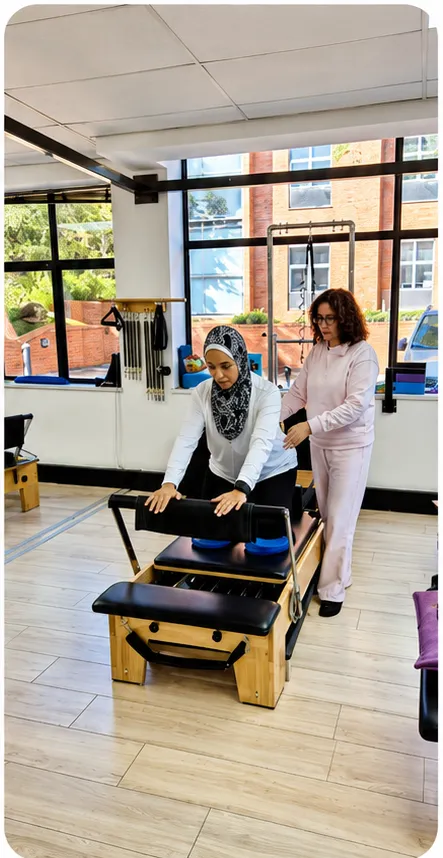
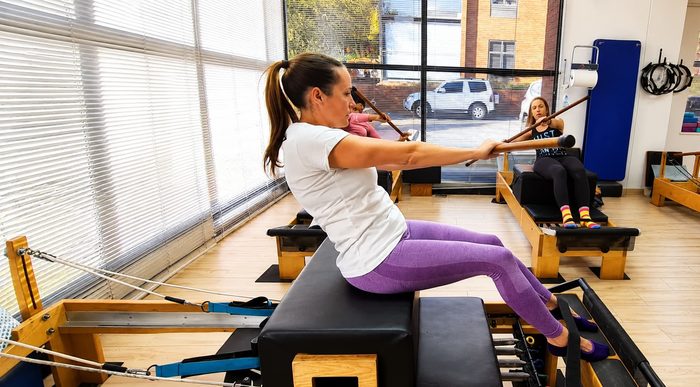
The Reformer is the best-known piece of Pilates equipment, and it was named for its purpose: to reform the body. It is a large frame topped with a flat, cushioned platform called the carriage. The carriage is attached to the frame by springs and slides as you push or pull with your legs or arms, either against a footbar or using long straps with handles.
Through a wide range of carefully sequenced movements, the Reformer gives a full-body workout. Its strengths include:
- Adaptability. Programmes can be built for beginners, rehabilitation or athletic training simply by changing springs, positions and exercises.
- Comfortable leg work. Many exercises are done lying on your back, so your legs can work without bearing your body weight, and muscles are recruited in a balanced way.
- Unique stretches. Some lower-body stretches on the Reformer can’t be reproduced as effectively on any other apparatus.
For a closer look at how the machine is built and used, read our guide to the Pilates Reformer machine.
The Pilates Wunda Chair
Like the Reformer, the Wunda Chair is one of Joseph Pilates’ resistance machines. It is essentially a padded box with a pedal on one side that you press down against springs. On some chairs the pedal is split in two, so each side can be worked independently.
The chair is small but demanding. Many exercises are done seated, standing or kneeling, so you have to control your balance as well as push the pedal. Chair work can:
- challenge balance and control, which makes it popular with advanced clients and athletes;
- work the lower back, glutes, shoulders, abdominals and pelvic area;
- improve co-ordination between the brain and muscles.
With suitable modifications it is also used with pre-natal clients. If you are pregnant, check with your doctor first and tell your instructor.
The Pilates tower
The tower is a frame fixed to the wall or a mat base, with springs, bars and straps attached at different heights. You sit, stand, or lie on your back or stomach and work against the springs to build strength, flexibility and muscular endurance. Because you work from a stable surface rather than a moving carriage, tower classes tend to feel a little more strength-focused.
The tower differs from the Reformer in a few useful ways:
- It places more emphasis on the hamstrings during leg work, for both flexibility and strength.
- It offers upper-body stretches that can’t be done on other apparatus.
- Leg work on the tower helps you avoid over-arching the lower back while gently lengthening it.
Like the other equipment, a tower programme can be adjusted for beginners or advanced clients.
Benefits of Reformer, tower and Wunda Chair classes
All three types of equipment strengthen the body’s “powerhouse” (abdominals, lower back, hips and glutes) along with the shoulders, arms and legs. Because the work focuses on alignment, balance and precise muscle engagement, many clients notice:
- better posture;
- improved balance and stability, especially when moving;
- greater range of movement and flexibility;
- a stronger, more controlled core.
The equipment also provides a low-impact workout. Exercises are done lying, sitting, kneeling or standing, with little force on your joints, yet the springs can make the work very challenging. There are hundreds of possible exercises, so classes stay interesting.
Why variety helps
Each apparatus challenges your body differently. Including Reformer, tower and chair work in your routine keeps your body adapting, which helps you keep progressing. If you are deciding between equipment and mat work, our comparison of Reformer and mat Pilates may help.
Starting equipment classes as a beginner
Our Reformer, tower and Wunda Chair group classes are open to all fitness levels, including people with little or no Pilates experience. We do ask every new client to book a beginner assessment first.
This is a private 55-minute session in which your instructor:
- asks about your goals and any injuries;
- checks your posture for imbalances and areas of weakness;
- teaches the basics: breathing, isolating the right muscles and keeping your spine, pelvis and joints aligned;
- shows you how to set up and operate the machines, so you can follow instructions in a group class.
Assessments can be booked at any time, depending on instructor availability.
What to bring
Bring a sweat towel and socks, as all exercises are done in socks. Anti-slip socks work best on the equipment.
Frequently asked questions
Are equipment classes harder than mat classes?
Not necessarily. The springs can make exercises easier, by giving support, or harder, by adding resistance, so classes can be pitched to your level.
How long is a class?
All adult classes are 55 minutes.
Book your first equipment class
Ready to try the Reformer, tower or Wunda Chair? Book your beginner assessment, view the class timetable or see current fees on our pricing page. You can also call 011 792 5459 or 072 999 2229, or email info@pilatesdynamics.co.za.