Proper form and posture in exercise: how Pilates helps
Why proper form and posture matter in exercise, what good alignment looks like and how Pilates teaches it. Learn to train safely and effectively.
Proper form and posture matter in exercise because they keep you safe, make each movement more effective, and make sure the right muscles do the work. When your joints are well aligned, your muscles can fire in the sequence they were designed for; when they’re not, other muscles compensate and joints take strain they weren’t built for. Pilates is built around teaching good alignment, which is why so many people use it to learn how to move well in the gym, in sport and in daily life.

Why proper form and posture matter in exercise
We often see people doing squats, planks or deadlifts with their backs rounded, knees collapsing inward or shoulders hunched up to their ears. Many don’t realise how much load poor alignment puts on their joints over time. If we want to stay active and pain-free for decades, how we move matters as much as how much we lift.
It makes your workout safer
Whether you’re lifting weights in the gym, carrying a heavy box above shoulder height or doing a squat, poor technique can set off a chain of compensations. The wrong muscles take over, joints are loaded unevenly and, sooner or later, something gets irritated or injured.
It makes your workout more effective
Engaging the correct muscles from the start means less wasted effort and better progress. Our joints are designed to sit in a precise relationship to one another, whether we’re moving or still. In that position the muscles around them can work efficiently and in the right order. In Pilates we teach you to work with a neutral pelvis and spine rather than a tucked (flat-back) or arched position, and to keep the pelvis level, so there are no unnecessary shearing forces through the lower back. Our article on neutral spine vs imprinted spine explains when each position is used.
It targets the right muscles
You want to feel fatigue in the muscles you’re training, not pain in your joints or tension somewhere unrelated. For example, certain deep abdominal muscles need to be engaged before you lift your legs off the mat so your lower back is protected. Rib placement matters too: if your ribs flare up during abdominal work, your back tends to arch away from the mat and you lose abdominal control, which increases the risk of strain.
How Pilates teaches good form
Breathing that matches the movement
In Pilates we pair muscle function with breathing. You’ll learn when to inhale and when to exhale based on which muscles assist each phase of the breath. We usually exhale during abdominal work because it helps recruit the abdominals, and inhale during trunk extension because the back extensors assist inhalation. Other muscles are active throughout, but the contraction tends to be more effective when it’s coordinated with the breath. Good breath control also helps with focus, stamina and recovery.
Strength balanced with mobility
Pilates strengthens the deep stabilising muscles while lengthening others, releasing tension and creating balance around the joints. Stretching is part of every programme: too much strength with too little mobility can pull the body out of symmetry and lead to injury just as easily as weakness can.
Attention to the shoulders and knees
The shoulder is a very mobile joint and therefore less stable than most, so shoulder blade placement is a big focus in Pilates. We pay similar attention to the knees, hips and feet, because the position of one joint affects all the others above and below it.
What does good standing posture look like?
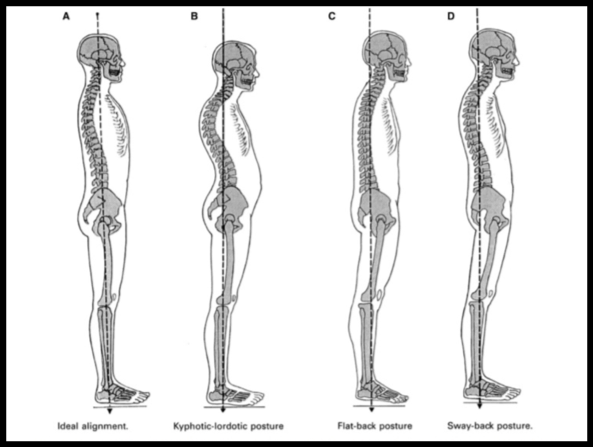
Look at the body from the side. There are four main masses of weight: the head, ribcage, pelvis and feet. The feet are the foundation, and their position affects everything above them. In ideal alignment, an imaginary plumb line runs from the feet to the head so that gravity is spread evenly through the body. That line passes through:
- the lobe of the ear
- the bodies of the neck vertebrae
- the middle of the shoulder joint
- the middle of the ribcage
- the hip joint
- slightly in front of the midline of the knee
- slightly in front of the ankle
There is also a front-to-back and side-to-side component, which affects things like shoulder blade position and whether the pelvis is level. Few people have perfect alignment, and that’s fine; the aim is to recognise your own habits and gradually improve them. If you’re wondering how quickly posture can change, read our post on how long it takes to correct posture with Pilates.
Frequently asked questions
Can a Pilates instructor help me learn proper form?
Yes. That is one of the main things a good instructor does. Small classes mean your instructor can watch your alignment and give you hands-on cues. If you’d like more one-on-one time to learn the fundamentals, private classes are available.
Will learning good form help with my gym or sports training?
It should. Once you understand neutral alignment, core engagement and breathing, you can apply them to squats, lifts, running and everyday tasks, so you train more safely on your own.
How do I know if my posture is out of balance?
Aches that keep returning, one side feeling tighter than the other, or shoes that wear unevenly can all be clues. A posture analysis is the easiest way to find out.
Learn proper form at Pilates Dynamics
Every new client at our Randburg studio starts with a 55-minute beginner assessment, which includes a posture analysis and an orientation, so we can teach you proper form and posture from your very first session. See current class options on our pricing page, or contact us on 011 792 5459, WhatsApp 072 999 2229 or info@pilatesdynamics.co.za.